
If you're here to claim your artwork, click below
Click below to claim your authenticated Anclude piece and finish registration.


Salvador Dalí
The Great Masturbator
The Great Masturbator
Couldn't load pickup availability
🖼 2 pieces → 5% off
🖼🖼 3 pieces → 10% off, free wall mount, free 📦
🖼🖼🖼 4 pieces → 15% off, 50% off shelf
🖼🖼🖼🖼 5+ pieces → 20% off
Details
Details
- Giclée fine art print
- Museum-grade archival pigment inks
- Printed on 240g acid-free, fine-art paper
- Glass-free presentation, no framing required
- Lean it against the wall or hang it with our accessories
- Backed by ClaimProof™ for authenticating and claiming
Dimensions
Dimensions
- Width: 12.6 in / 27 cm
- Height: 10.6 in / 32 cm
- Depth (thickness): 0.6 in / 15 mm
- Weight: 1.3 lb / 580 gr
Shipping & Returns
Shipping & Returns
Ships from the U.S.
Returns accepted within 14 days of delivery, unused and in original packaging.



More About The piece
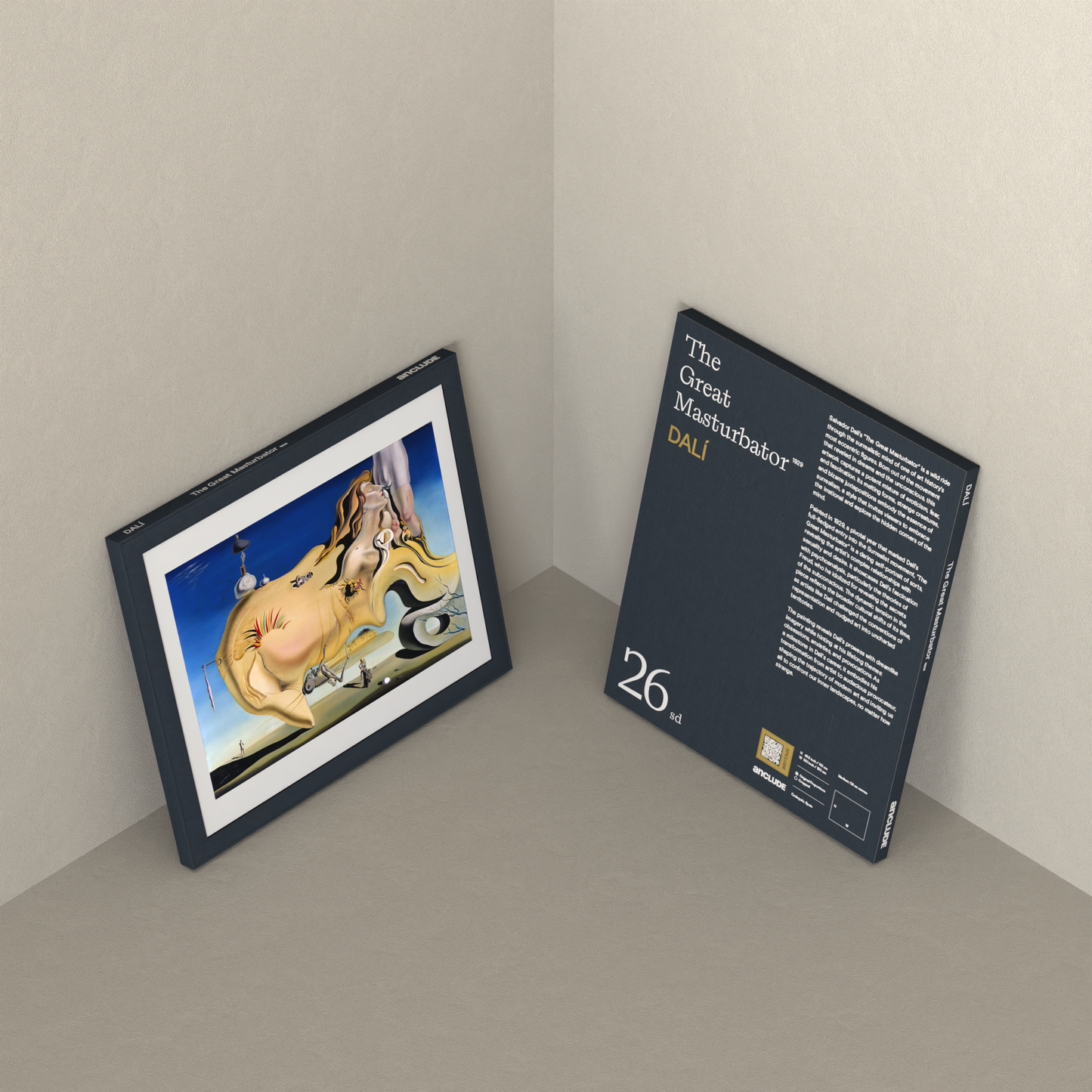
Salvador Dalí's "The Great Masturbator" is a wild ride through the surrealistic mind of one of art history's most eccentric figures. Born out of the movement that reveled in dreams and the unconscious, this artwork captures a potent mixture of eroticism, fear, and fascination. Its melting forms, strange creatures, and bizarre juxtapositions embody the essence of surrealism, a style that invites viewers to embrace the irrational and explore the hidden corners of the mind.
Painted in 1929, a pivotal year that marked Dalí's full-fledged entry into the Surrealist movement, "The Great Masturbator" is a daring self-portrait of sorts, revealing the artist's complex relationships with sexuality and desire. It showcases Dalí's fascination with psychoanalysis, particularly the theories of Freud, who he idolized for revealing the secrets of the subconscious. The dynamic tension in the piece reflects the broader cultural shifts of its time, as artists like Dalí challenged the conventions of representation and nudged art into uncharted territories.
The painting reveals Dalí's prowess with dreamlike imagery while hinting at his lifelong themes: obsessions, anxieties, and provocations. As a milestone in Dalí's career, it embodies his transformation from artist to audacious provocateur, shaping the trajectory of modern art and inviting us all to confront our inner landscapes, no matter how strange.