
If you're here to claim your artwork, click below
Click below to claim your authenticated Anclude piece and finish registration.


René Magritte
The Sixteenth of September
The Sixteenth of September
Currently shipping within the United States only.
Couldn't load pickup availability
🖼 2 pieces → 5% off
🖼🖼 3 pieces → 10% off, free wall mount, free 📦
🖼🖼🖼 4 pieces → 15% off, 50% off shelf
🖼🖼🖼🖼 5+ pieces → 20% off
Details
Details
- Giclée fine art print
- Museum-grade archival pigment inks
- Printed on 240g acid-free, fine-art paper
- Glass-free presentation, no framing required
- Lean it against the wall or hang it with our accessories
- Backed by ClaimProof™ for authenticating and claiming
Dimensions
Dimensions
- Width: 10.6 in / 27 cm
- Height: 12.6 in / 32 cm
- Depth (thickness): 0.6 in / 15 mm
- Weight: 1.3 lb / 580 gr
Shipping & Returns
Shipping & Returns
Ships from the U.S.
Returns accepted within 14 days of delivery, unused and in original packaging.


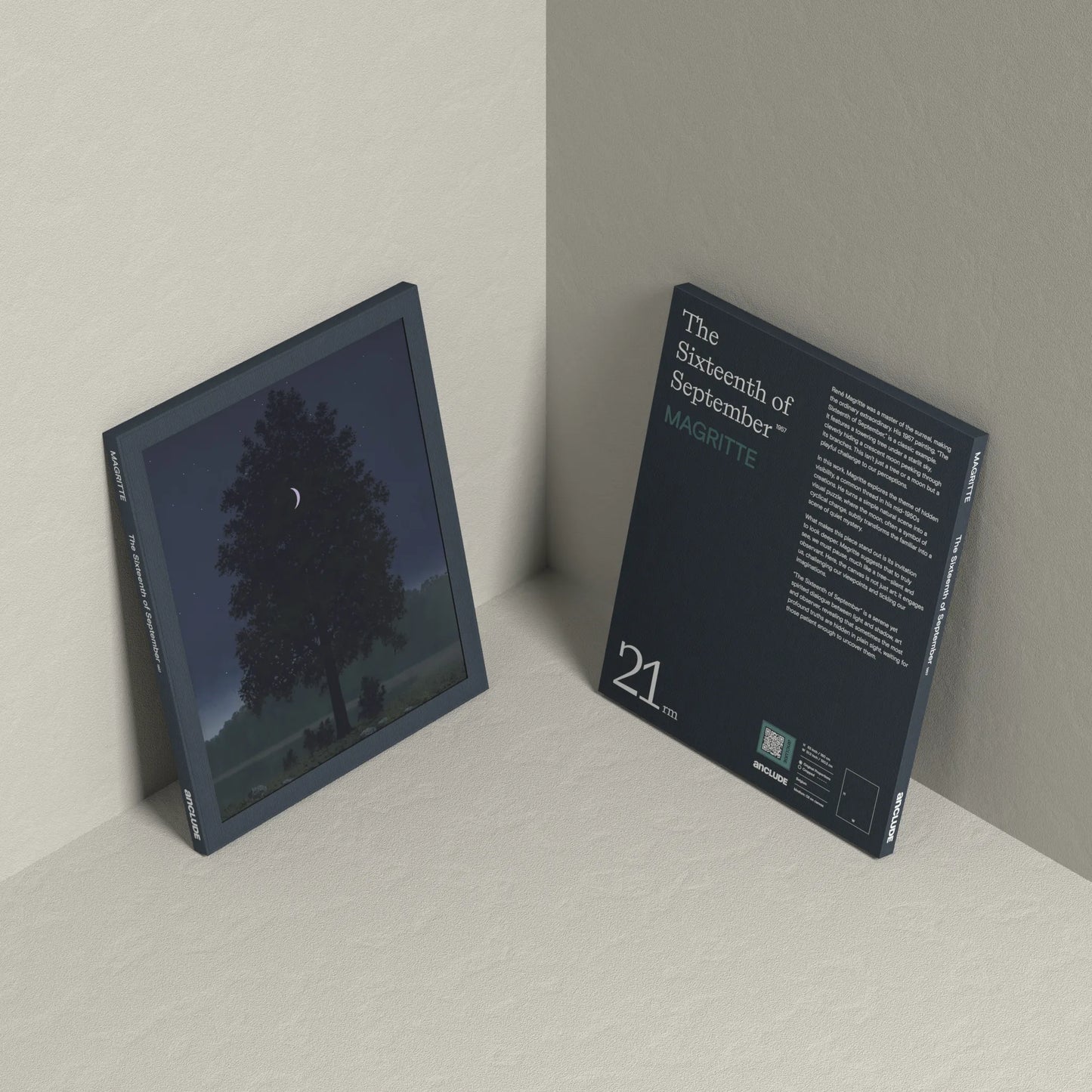


More About The piece
René Magritte was a master of the surreal, making the ordinary extraordinary. His 1957 painting, “The Sixteenth of September,” is a classic example. It features a towering tree under a starlit sky, cleverly hiding a crescent moon peeking through its branches. This isn’t just a tree or a moon but a playful challenge to our perceptions.
In this work, Magritte explores the theme of hidden visibility, a common thread in his mid-1950s creations. He turns a simple natural scene into a visual puzzle, where the moon, often a symbol of cyclical change, subtly transforms the familiar into a scene of quiet mystery.
What makes this piece stand out is its invitation to look deeper. Magritte suggests that to truly see, we must pause, much like a tree—silent and observant. Here, the canvas is not just art; it engages us, challenging our viewpoints and tickling our imaginations.
“The Sixteenth of September” is a serene yet spirited dialogue between light and shadow, art and observer, revealing that sometimes the most profound truths are hidden in plain sight, waiting for those patient enough to uncover them.