
If you're here to claim your artwork, click below
Click below to claim your authenticated Anclude piece and finish registration.


René Magritte
The Empire of Light
The Empire of Light
Currently shipping within the United States only.
Couldn't load pickup availability
🖼 2 pieces → 5% off
🖼🖼 3 pieces → 10% off, free wall mount, free 📦
🖼🖼🖼 4 pieces → 15% off, 50% off shelf
🖼🖼🖼🖼 5+ pieces → 20% off
Details
Details
- Giclée fine art print
- Museum-grade archival pigment inks
- Printed on 240g acid-free, fine-art paper
- Glass-free presentation, no framing required
- Lean it against the wall or hang it with our accessories
- Backed by ClaimProof™ for authenticating and claiming
Dimensions
Dimensions
- Width: 10.6 in / 27 cm
- Height: 12.6 in / 32 cm
- Depth (thickness): 0.6 in / 15 mm
- Weight: 1.3 lb / 580 gr
Shipping & Returns
Shipping & Returns
Ships from the U.S.
Returns accepted within 14 days of delivery, unused and in original packaging.




More About The piece
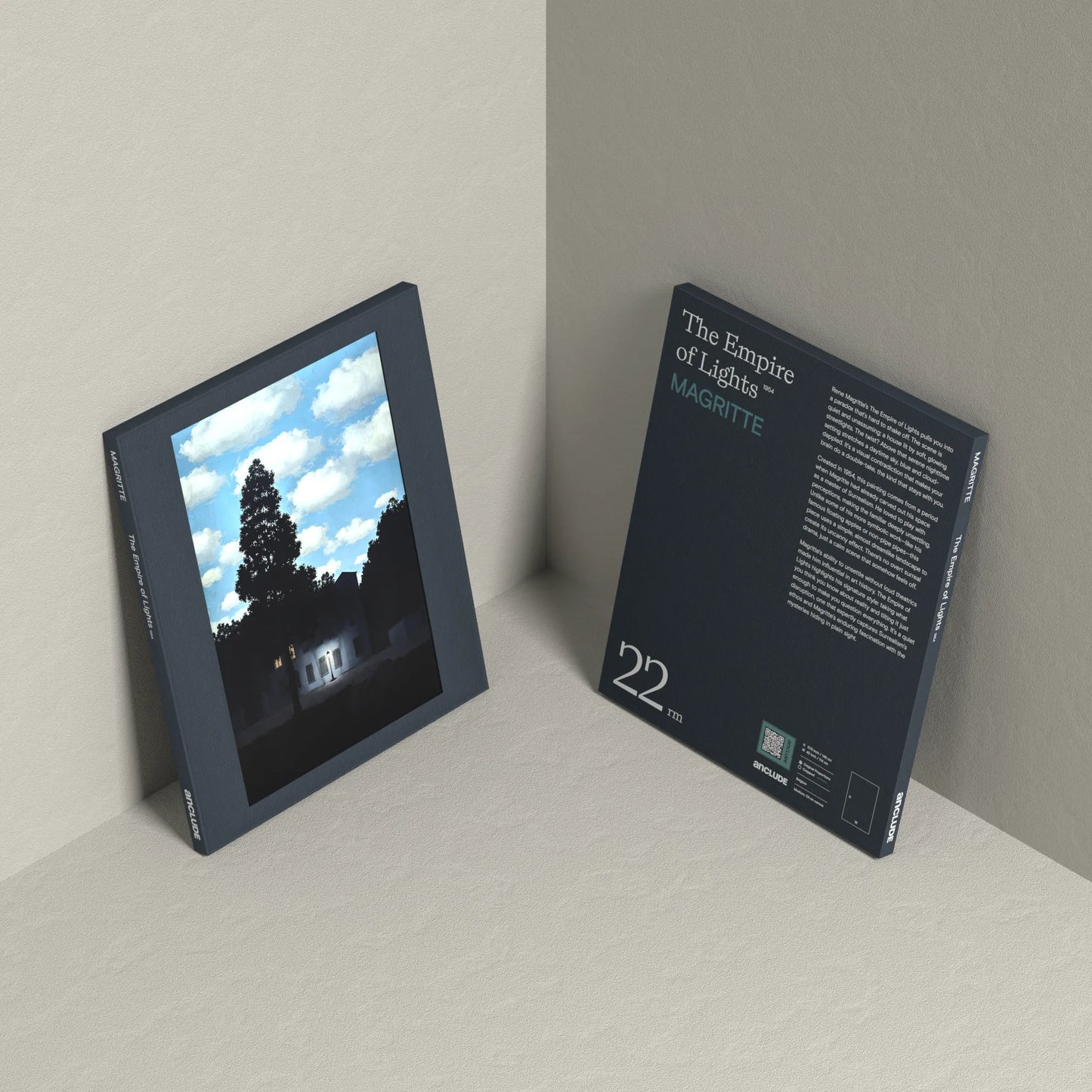
Rene Magritte’s The Empire of Light pulls you into a paradox that’s hard to shake off. The scene is quiet and unassuming: a house lit by soft, glowing streetlights. The twist? Above that serene nighttime setting stretches a daytime sky, blue and cloud-dappled. It’s a visual contradiction that makes your brain do a double-take, the kind that stays with you.
Created in 1954, this painting comes from a period when Magritte had already carved out his space as a master of Surrealism. He loved to play with perceptions, making the familiar deeply unsettling. Unlike some of his more symbolic work—like his famous floating apples or non-pipe pipes—this piece uses a simple, almost dreamlike landscape to create its uncanny effect. There’s no overt surreal drama, just a calm scene that somehow feels off.
Magritte’s ability to unsettle without loud theatrics made him influential in art history. The Empire of Light highlights his signature style: taking what you think you know about reality and tilting it just enough to make you question everything. It’s a quiet disruption, one that expertly captures Surrealism’s ethos and Magritte’s enduring fascination with the mysteries hiding in plain sight.