
Learn
What makes Monet’s Woman with a Parasol so distinctive?
In Woman with a Parasol, Monet gives Camille the force of a portrait and Jean a quieter counterweight, all within the wind, light and broken color of Impressionism.

When people think of Monet, they tend to think of a place before they think of a person.
There is the pond at Giverny. There are the haystacks. There is Rouen Cathedral, which Monet painted so many times that one begins to suspect the cathedral had very good representation. His great subjects seem to be water, gardens, weather and the slightly unnerving fact that the same thing can look entirely different at 8 a.m. and 5 p.m.
Monet also painted people: his wife Camille, modern crowds, riverside holidaymakers, women in gardens and children in fields. In many of those paintings, people give the scene its scale or bustle. They make a field feel occupied rather than empty. They let a street move.
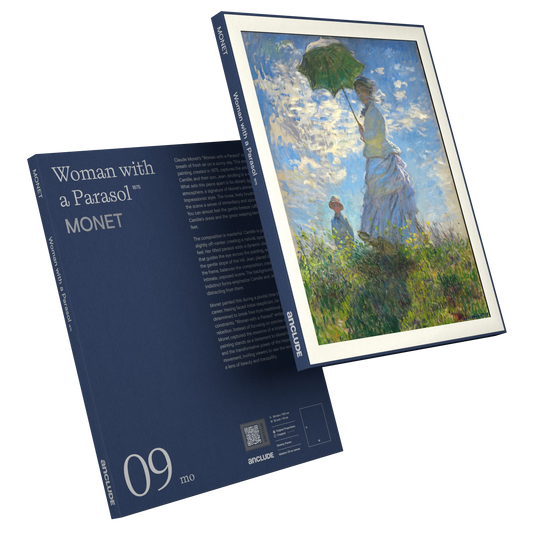
Then there is Woman with a Parasol (Madame Monet and Her Son), painted in 1875.
Camille is not there to make the hill look larger. The hill is there, in part, to make Camille look larger. Yet this is no conventional portrait. It is a painting about a woman, certainly, and also about a gust of wind, a shifting patch of sun and the speed with which a moment changes before it can settle.
Camille holds the center of the picture without becoming separate from the world around her. That is what makes the painting distinctive.


The problem of people in a Monet
A person is a complicated thing to put in an Impressionist painting.
A formal portrait invites us to settle in. Here is the face. Here are the clothes. Here is a carefully arranged room, perhaps a chair that has spent far more time being painted than sat on. The sitter holds still long enough for us to take stock.
Impressionism begins elsewhere. Light breaks over a surface. A shadow turns blue, violet or green. A crowd becomes movement before it becomes individual faces. The paint stays visible, so the experience does not look fixed.
In many of Monet’s people paintings, the setting takes the lead. In La Grenouillère, the bathers and visitors along the Seine join the scene’s visual traffic. Your attention skips between water, floating platform, trees and crowd. In Poppy Fields near Argenteuil, figures give rhythm and scale to a field already alive with color. In Women in the Garden, made earlier in Monet’s career, the women form an ensemble within the garden’s elaborate design.
Even La Japonaise, in which Camille occupies the canvas with impressive authority, is a different kind of picture. Its drama comes from costume, pattern and performance. It asks us to notice the spectacle.
Woman with a Parasol brings a single figure forward while keeping her inside a particular arrangement of air, grass, light and movement.


Camille gets the sky
The painting’s point of view does a great deal of work before we have had time to notice it.
We look up at Camille from below. The hill lifts her above us, and the large stretch of sky behind her gives her the space a portrait usually reserves for a dark curtain or an expensive interior. Her parasol reaches toward the top of the canvas.
Jean, their son, stands lower in the grass. He is smaller, quieter and more squarely turned toward us. That does more than keep him out of Camille’s way. His presence gives the hill a second human scale, so Camille’s height and prominence feel deliberate rather than merely theatrical. Camille has turned to look back. Jean is already looking out. The two glances make the scene feel less like a posed image and more like something caught in progress.
The composition gives Camille the force of a person you have encountered, not merely a figure glimpsed at the edge of a landscape.
Conventional portraiture often offers stillness and a settled setting. Here, Camille’s body moves forward while her face turns back. The veil shifts. The dress catches the wind. The parasol is not a polite accessory. It seems to be negotiating with the sky.
Her turned head leaves us with the unsettled sensation that she has just looked back and may look away again before we have understood the scene.
A portrait that behaves like Impressionism
Impressionist technique makes this portrait work.
The white of Camille’s dress keeps changing. It picks up blue from the sky, green from the grass and warmer notes from the light. Its shadows carry color instead of simply getting darker. The sky is built from separate marks that keep it moving. Grass, fabric, veil and cloud belong to one visual event.
This is how Impressionism works at its most persuasive. Instead of beginning with objects that have settled, permanent colors, Monet begins with the conditions of looking. What is the light doing? What is the air doing? How does a white dress change when it is surrounded by blue sky and green ground?
Camille seems briefly revealed by the landscape rather than placed in front of it.
The brushwork lets that happen. A clean academic finish would make the veil more precise, the grass more botanical and the face more fully modeled. It would also slow the whole scene down. Monet gives us enough to recognize each thing and then lets the marks keep moving. We see a woman and the paint that makes wind, brightness, fabric and light visible. Woman with a Parasol is one of my favorite Monet paintings, which is why I chose it for Anclude’s first series and why it became our first Monet reproduction.