
Learn
Manet’s last masterpiece: The mirror that shouldn’t work

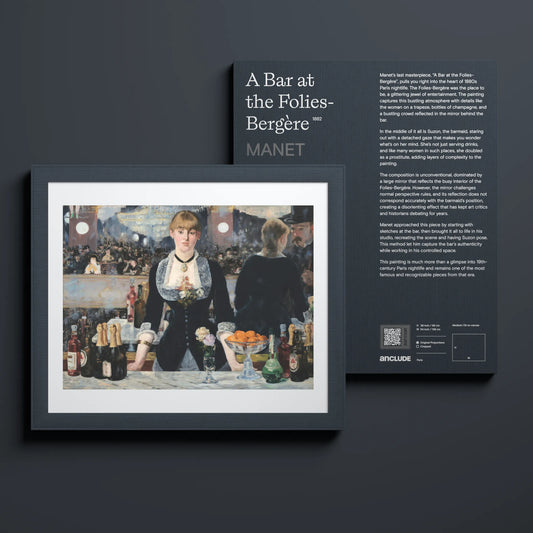
Édouard Manet’s A Bar at the Folies-Bergère is one of his most iconic works. Its mirror has kept art historians arguing for generations over whether the reflection could exist in a real room.
The puzzle is easy to spot. A woman stands behind a counter, facing us. In the mirror behind her, her back appears far off to the right, beside a man in a top hat. If we are looking straight at her, how did her reflection get over there? And where is the man whose reflection we can see?
For much of the painting’s history, those inconsistencies were treated as impossible to reconcile with ordinary perspective. Manet seemed to have made a mirror that refused to behave like a mirror.
Later research showed that an unexpected viewing position could explain much of the arrangement. Some of the apparent mistakes could happen in a real room. But the explanation comes with assumptions, and the painting keeps giving us reasons to question them.

We’ll look at two illustrated theories about the mirror. First, it helps to know where this painting came in Manet’s career and what else he put into the scene.
Manet’s last major painting
Manet painted the work in 1882 and showed it at that year’s Paris Salon. He died the following year. It was his last major painting, made after a career spent bringing contemporary life into pictures that challenged how people expected serious art to look.
His subjects included cafés, fashionable crowds, leisure and encounters whose social meaning could be uncomfortable. Here he returned to the Folies-Bergère, a Parisian entertainment hall where a night out included performances, drinking and watching the other people in the room.
The barmaid was an employee named Suzon. Manet knew the venue and sketched there, but painted the finished work in his studio, with Suzon posing for him. The picture’s seemingly casual encounter was built through preparation and revision.
The crowded hall behind her is a reflection. A large mirror fills most of the background, bringing the room on our side of the counter into the painting. At the upper left, a trapeze performer’s green boots enter the frame. The rest of the act is somewhere beyond its edge.
That arrangement lets Manet give us a public spectacle and a close encounter at once. The crowd is loosely painted, its faces and lights dissolving into marks. Suzon is still and sharply present by comparison. The bottles, oranges and flowers bring color and recognizable things right up to the front.
Even before we try to solve the mirror, that contrast holds the picture together. A busy evening surrounds a woman whose expression gives little away. We can identify what is for sale more readily than we can understand what she is thinking.
Why the mirror looks wrong
Imagine a flat mirror running parallel to the bar. If we stand directly opposite Suzon, her reflection should sit behind her, partly hidden by her body. That is where the painting seems to put us: she faces forward, and her hands rest evenly on the bar. Yet her reflected back appears far to the right, beside a man whose body is nowhere in our direct view. The bottles on the left do not line up with their reflections either.

Theory 1: Move the observer
Art historian Malcolm Park tested an off-center view by building and photographing a version of the scene. Move the observer to the right and have Suzon turn toward them. She can still look directly at us while her reflection shifts across the mirror. The man can stand beyond our direct field of view and still appear in the reflection. His photograph produces that broad displacement in a real room.

That explains the pair, but it asks us to see Suzon as turned relative to the bar. Facing an observer off to one side would angle her body to the counter, even if she looks frontal to that observer. In the painting, her shoulders and hands seem square to the bar. Her nose, necklace, bodice and skirt form a strong central line. The turn this theory needs is hard to find.

The counter adds another objection. Its reflected edge seems to lead toward a viewpoint near Suzon’s face, reinforcing the sense that we stand centrally. The bottles we see on the bar do not simply match the reflected bottles. In a fuller version of the off-center theory, some reflections belong to bottles outside our view, and the counter has a trapezoidal outline. These additions account for more of the picture, but depend on objects and geometry we cannot see directly.

Theory 2: Keep the observer centered
Art historian Thierry de Duve starts with Suzon’s frontal stance. He keeps the observer centered and asks whether Manet combined two arrangements. In one, the mirror is parallel to the picture plane and the man is outside our view. In the other, the mirror pivots and the man stands before Suzon. These are two ways of constructing what appears on the canvas, not successive moments in a conversation.

This preserves the feeling that we face Suzon head-on while keeping the reflected man on the right. It treats the picture as a combination of views, rather than claiming every object occupied one real arrangement. The bottles remain unexplained, and we have no account from Manet saying this is how he meant the painting to work.

What the mirror changes about the people
Where we stand changes the encounter. If we occupy the customer’s place, Suzon seems to face us across the bar. If the man stands elsewhere, we watch an exchange from outside it.
Her reflection seems attentive to the man. Her frontal face is harder to read. She might look tired, detached or patient, but the painting gives us no exchange to settle any of those readings.
Contemporary viewers often assumed barmaids in places like this were sexually available. That assumption has shaped readings of Suzon as another attraction on display beside the drinks. It tells us about expectations around her work, not her personal life.
Other readings question why the male customer should organize the whole scene. Women also came to such venues as spectators and consumers. Some interpretations connect Suzon’s divided presentation to Manet himself. The mirror leaves our position uncertain, along with whose experience we take to be central.

Look at Suzon again. She seems to stand square to the bar, while her reflection appears far to the right. We may never know whether either reconstruction fully explains the mirror, or whether Manet wanted it to trouble our view. Either way, the hall glitters behind Suzon, she remains still and hard to read, and we cannot quite place ourselves in the room. Manet’s last major work is extraordinary with or without a solution to the mirror.